


Some readers might find it odd to even entertain the possibility that China has fewer people living in poverty than the US. China’s GDP per capita is about one-sixth of the US’ — one-third once you adjust for purchasing power. Given a gap that large, surely China must have far more people living in poverty, right?
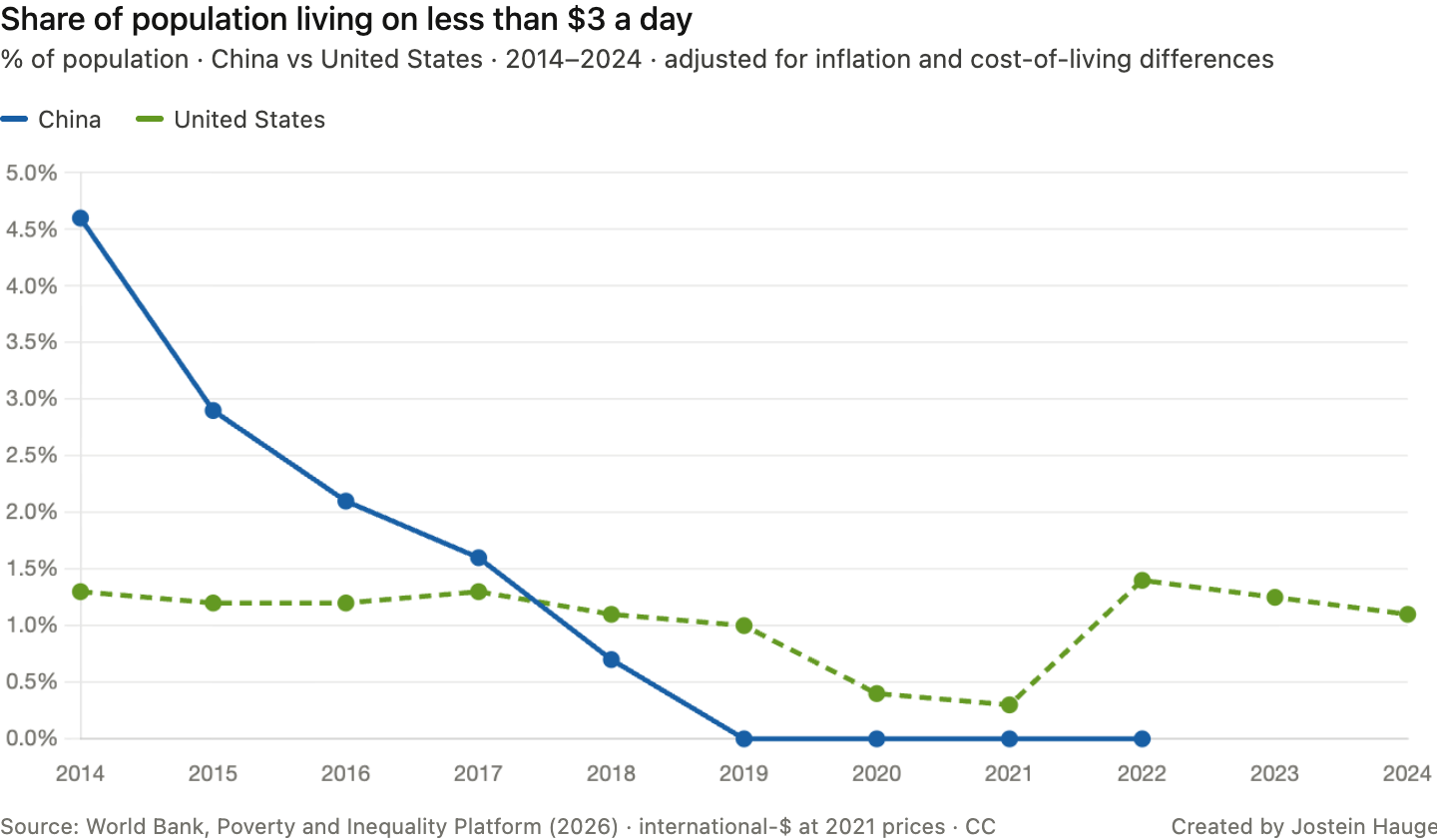
Data from the World Bank challenges this intuition. According to the Bank, extreme poverty in China was eradicated by 2019, while the rate in the US still sits at around 1%. Extreme poverty here is defined as living on less than $3 per day, adjusted for differences in cost of living. So on the World Bank’s own benchmark, more Americans live in extreme poverty than Chinese, not only as a share of the population but also in absolute numbers, seeing that China has officially eradicated poverty.
Reasons to believe poverty is understated in the US
The most common objection to the comparison made above is that the poverty rate in the two countries is measured differently. The World Bank’s China numbers are calculated based on consumption (what households spend); the US numbers based on income (what households earn). An oft-cited argument is that this measurement difference overstates the US poverty rate relative to China, because the income measure in the US does not take into account government transfers like the Supplemental Nutrition Assistance Program (SNAP) and tax credits that lift households’ actual standard of living above what their paychecks suggest.
It’s a fair point, but only to a degree. There are strong counterarguments suggesting that poverty figures are often understated in the US, not overstated. The US poverty threshold was originally derived from the cost of food, then multiplied to cover everything else. It was never built around a basket that includes services that cover basic needs such as healthcare, higher education, or transport — precisely the things that are ruinously expensive in a country with privatised medicine, costly universities, and thin public transit.
Three further problems compound this. The first is that the threshold barely varies by geography. A family in Manhattan or San Francisco faces housing costs many times those in rural Mississippi, yet the poverty line is nearly identical across both. The result is that a large number of working families who clear the official bar are still, in any meaningful sense, housing poor.
The second is that an income snapshot ignores assets. A household can post a modest income while carrying heavy debt, holding no savings, and having no cushion for a sudden shock. This is not a fringe phenomenon: the share of Americans who say they could not cover a $400 emergency expense is consistently far larger than the official poverty rate. Income flow and financial security are not the same thing, and only one of them shows up in the statistics.
The third is what people report when you ask them directly. Material hardship surveys — can you afford food, utilities, medical care, adequate clothing? — routinely turn up more deprivation than the official headcount.
It should come as no surprise then that US government agencies set the domestic poverty line much higher than the World Bank’s international definition for extreme poverty. The official US poverty line, set by the Department of Health and Human Services, is an income of $32,000 a year for a family of four. This would translate to roughly $22 per day per person. By this measure, approximately 11% of Americans live in poverty. The US Census Bureau’s own Supplemental Poverty Measure, which factors in both non-cash benefits and real expenses, raises the US poverty rate to 13%.
Reasons to believe poverty — at a higher threshold — is overstated in China
When comparing the poverty rate in both China and the US, the most interesting challenge to my opening chart isn't about measurement method — it is about the international poverty line itself. There is no clear consensus on an international poverty line, but some scholars argue that around $10 per day, adjusted for differences in cost of living, is not unreasonable for capturing real deprivation. So what happens to the comparison at that threshold?
It flips. At $10 per day, 31% of China’s population falls below the line, against just 2% in the US. On this measure, poverty in China is overwhelmingly higher.
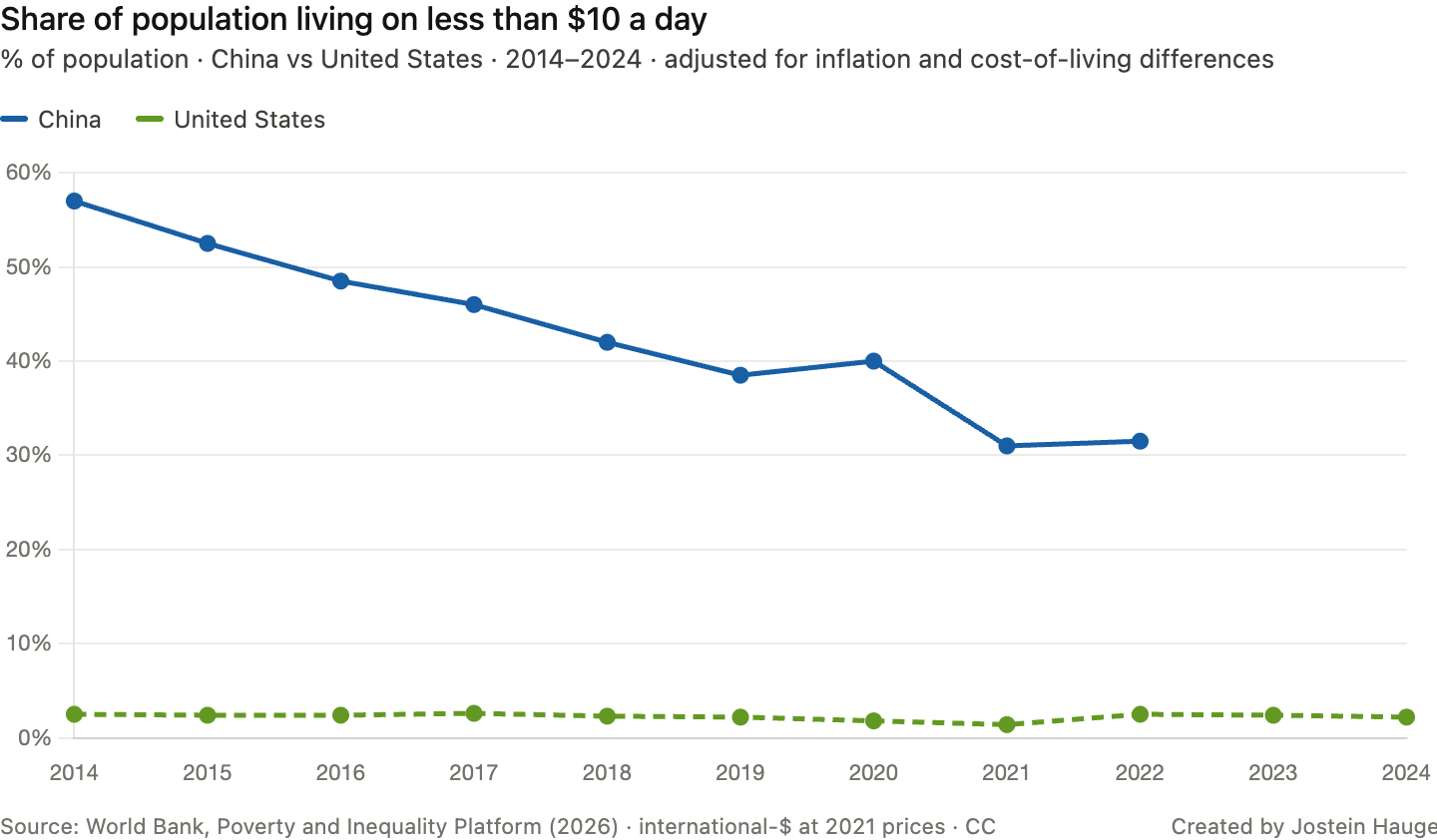
Again, the argument that the US poverty rate is substantially higher than 2%, as made in detail above — and which US government agencies also support — goes for this chart as well.
Additionally, there is reason to believe that a $10 per day line overstates true deprivation in China. Market-based poverty measures don’t fully register that poor people in China need to consume less in cash terms, because so much of what sustains a decent life is cheap or free at the point of use. This could be why the official poverty line used by the National Bureau of Statistics in China is roughly equivalent to the $3 per day line used by the World Bank.
Consider what a decent life from a material point of view generally requires: affordable housing, electricity, clean water, sanitation, internet, access to transport, nutritious food, basic healthcare, and schooling (to name a few). In China, these are now close to universal, including across the rural areas where poverty is concentrated. In the US they are not. And much of this simply doesn’t show up in a household’s measured purchasing power, whether you measure it through income or consumption.
Three things drive this gap. The first is China’s decades-long commitment to fighting poverty, with a heavy focus on building infrastructure. As an explicit part of poverty eradication efforts, China’s government has poured money into roads, railways, electrification, clean water, mobile data, and rural clinics. These government investments lift living standards far beyond what a consumption or income figure can capture, which means people are less deprived in real terms than the raw number implies. The second is the rural cost of living, which is very low. A small cash income combined with subsistence agriculture, communal land rights, and subsidised housing buys a standard of living that dollar-based comparisons systematically undersell, even when adjusted for differences in cost of living. The third is in-kind provision: the dibao minimum-income scheme, cooperative medical insurance, and free schooling all add real value that an income or consumption line never counts.
Stuff versus basic needs
None of this means the Chinese middle class out-earns the American one. It does not. A US middle-class family commands far more purchasing power over discretionary “stuff,” and is more likely to own a suburban house with a backyard than to live in an apartment block.
My main point, however, is this: the quantity of stuff you can buy — whether this is calculated based on your income or consumption patterns — is not a great proxy for material wellbeing. A family that can buy more things but lies awake over a medical bill, mounting education costs, or monthly rent that eats up the monthly paycheck is not obviously better off, in material terms, than one that buys less but rarely has to worry about sudden financial ruin.
So where does that leave the original question? Both countries have very low rates of extreme poverty — that much is clear. Push the line higher and China’s poverty rate rises above America’s in terms of money in people’s pockets. But once you account for what the US line understates and what the China line (at a higher threshold) overstates, there’s a strong case that at the bottom of the distribution — the people the term “poverty” is really meant to describe — the US has more of them as a share of the population (in line with the World Bank figures), and potentially also in absolute terms. The reason? China covers basic needs for its poor; the US doesn’t.
Excellent essay! It reminds me of the numerous homeless I encountered in NY, Washington and SF. The statistics is powerful and credible, and I think it becomes even clearer when we look beyond the extreme poverty line itself.
The surprising fact is not simply that China may now have fewer people living in extreme poverty than the United States. The deeper question is: how can the richest country in the world still allow millions of people to fall below such a low threshold?
This is exactly the issue I tried to examine in my earlier essay, “Why Are the Rich in the US Richer Than Those in China While the Poor Are Poorer?”
The United States is not poor. It is extraordinarily rich. Its problem is that wealth is concentrated at the top while the bottom of society has very little balance-sheet protection. The top 1% in the US owns an enormous share of national wealth, while the bottom 50% owns almost nothing. Many low-income Americans may have higher annual income than low-income Chinese households, but they often have very weak household assets, limited savings, high debt exposure, expensive healthcare, and a thinner social safety net.
That is why the comparison with China is so interesting.
China is still much poorer than the United States in per capita GDP terms. It is not a high-income welfare state. It still has low-income households, regional inequality, urban-rural gaps, employment pressure, and many forms of relative poverty. But China has built a system that is much better at preventing the bottom from falling through the floor.
Part of this comes from rapid industrialization. Part of it comes from infrastructure. Part of it comes from basic public services, rural land and housing arrangements, family savings, targeted poverty alleviation, and a state system that treats extreme poverty as a governance failure rather than merely an unfortunate market outcome.
This is where the US-China contrast matters. In the US, the rich are richer because the system is extremely good at rewarding capital, equity ownership, financial assets, executive compensation, and high-end professional income. But the poor are poorer because the same system leaves the bottom with very little asset cushion and very high exposure to medical shocks, job loss, debt, rent, and homelessness.
In China, the rich are generally less rich than the American rich, but the bottom is less likely to be completely abandoned. The Chinese system does not eliminate inequality. It does not provide European-style welfare. But it does maintain a broader floor under society.
Your main point is too rarely acknowledged. Well-being is driven less by how much stuff you have than how confident you are that you will have the right amount of the right stuff at the right time.