

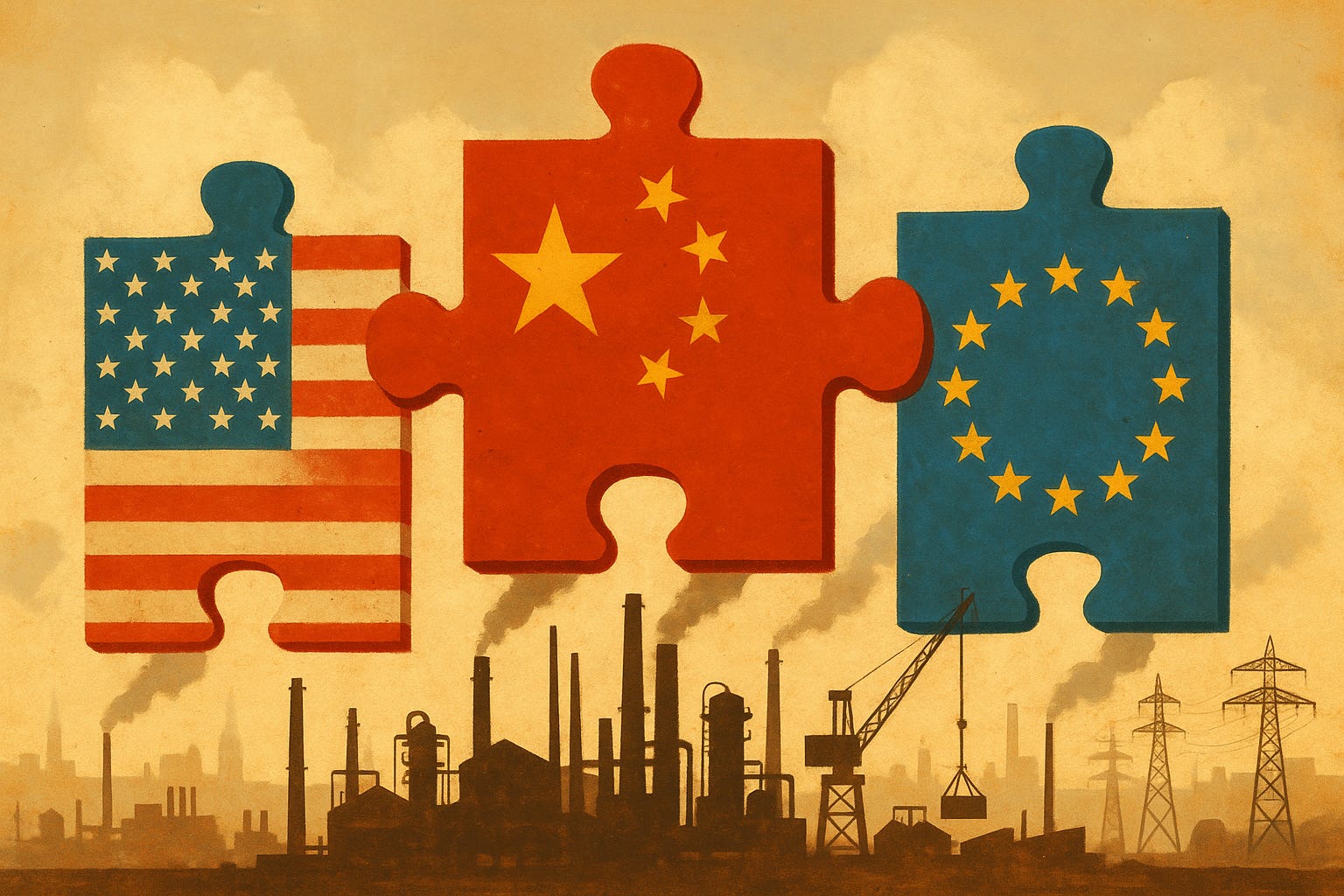
The global economy is undergoing a fundamental shift. After decades of free-market orthodoxy and neoliberal globalization, we’re witnessing the return of industrial policy — but this time with a twist. Major economic powers — especially the United States, China, and the European Union — are now explicitly intertwining their economic strategies with national security concerns. This isn’t just a policy adjustment. It represents a wholesale transformation of how major powers approach economic development and competition.
These three economic giants are implementing distinct approaches to industrial policy while pursuing similar objectives: technological leadership, supply chain security, and national economic sovereignty. What we’re seeing is the emergence of a new economic nationalism, one that is reshaping the global economic order.
Industrial policy as national security strategy: nothing (entirely) new under the sun
Here’s something that often gets lost in contemporary debates: while the fusion of industrial policy and national security has contemporary features that make it distinct, it also has deep historical roots that stretch back centuries.
Alexander Hamilton, writing in the late 18th century, understood that economic prosperity wasn’t just about wealth creation — it was fundamentally connected to national independence and security. His insights laid the groundwork for America’s own industrial catch-up strategy against Great Britain. As he put it, “Not only the wealth; but the independence and security of a Country, appear to be materially connected with the prosperity of manufactures.”
This thinking wasn’t confined to the United States. In Japan, Fukuzawa Yukichi influenced the strategic use of protectionist policies during the Meiji Restoration. In Africa, Kwame Nkrumah argued that industrialization was essential not just for economic development, but as the material basis for national freedom and independence from colonial powers. Latin American dependency theory similarly emphasized how industrial policy could help peripheral economies break free from exploitative international trade structures that favoured the global North.
The crucial point is this: neomercantilism — the idea that countries should actively use industrial and trade policies to generate trade surpluses and enhance competitiveness — has always viewed economic power and national security as inseparable. So, what we’re witnessing today isn’t the invention of something entirely new, but rather the resurrection of ideas that were temporarily suppressed during the neoliberal era of the 1980s onwards.
During that period, international organizations effectively outlawed industrial policy through structural adjustment programmes and free trade agreements. The Washington Consensus reigned supreme. But the 2008 financial crisis, rising inequality, climate change pressures, supply chain vulnerabilities exposed by COVID-19, and intensifying geopolitical tensions have collectively demolished faith in free-market orthodoxy. Industrial policy is back. And it’s back with a vengeance.
The securitization of economic policy
What distinguishes today’s industrial policy renaissance from historical precedents is the explicit securitization of economic competition. National security has been reconceptualized to encompass economic vulnerabilities that were previously viewed as mostly commercial concerns.
The COVID-19 pandemic was a wake-up call. When safety measures shut down production worldwide, the fragility of global supply chains became painfully apparent. Russia’s invasion of Ukraine compounded these concerns, as physical blockades and economic sanctions led to global price spikes in oil, gas, wheat, and fertilizer. Suddenly, dependence on foreign suppliers was a strategic liability.
But the bigger driver has been China’s rise. From 2000 to 2022, China’s share of global manufacturing exploded from 6% to 31%, with projections suggesting it could reach 45% by 2030. China’s rise represents a fundamental challenge to the established global hierarchy, and has played a huge part in resurrecting industrial policy as national security strategy in the West. Additionally, China’s success with state capitalism and long-term industrial planning has upended the assumption that free markets are the only path to prosperity.
The West’s response to China’s rise has been comprehensive. The United States has adopted an explicitly hawkish stance toward China, implementing extensive export controls, tariffs, investment screening, and domestic industrial subsidies. The European Union has chosen a more measured approach, balancing strategic autonomy and regulations on inward investments with trade openness. In China, although industrial policy has been a staple of state planning for decades, national security considerations have become even more deeply integrated into its development strategy in light of growing geopolitical tensions. Beijing is now pushing even harder for technological self-sufficiency and manufacturing dominance across a range of sectors and nodes of supply chain.
Economic competition and industrial policy has now been genuinely ‘securitized’. The distinction between economic and security concerns has effectively collapsed.
Global ramifications: who wins and who loses?
This brings us to the most important question: what does this mean for the rest of the world?
The reality is complicated, with both worrying trends and genuine reasons for hope. To properly understand the implications, we should evaluate these developments from an international development perspective, not just through the lens of great power competition.
Let’s start with the concerning aspects. Industrial policy is, by definition, about economic competition between nation states. One country’s industrial success often comes at another country’s expense. When the United States, China, and the European Union simultaneously ramp up their industrial policies, they’re highly likely to, collectively, dominate an even larger share of global manufacturing. In 2023, these three regions accounted for 69% of global manufacturing output, up from 61% in 2000. This concentration is projected to increase further.
For lower-income countries, this creates serious challenges. They simply don’t have the economic muscle to launch competitive industrial policies on the scale of the strategies such as the CHIPS and Science Act or Made in China 2025. Recent research shows that there is a strong positive correlation between domestic financial capacity and the ability to pursue industrial policy. Countries with limited resources are effectively shut out of this new competition for industrial supremacy. The risk is that their industrial capabilities could stagnate or even erode as the major powers consolidate their dominance.
But here’s where we need to complicate the narrative. The picture is far more nuanced than this suggests, and there are several reasons for genuine optimism.
First, we should celebrate China’s industrial success from a development perspective. Since 1980, China has lifted more people out of poverty than the rest of the world combined. China’s rise has entailed more than a billion people experiencing dramatic improvements in living standards. If we care about reducing global poverty, China’s economic ascent is unambiguously positive. Moreover, China is leading global efforts in renewable energy manufacturing, now accounting for 65-82% of the global market share across solar panels, wind turbines, lithium-ion batteries, and electric vehicles. This isn’t just helping China — it’s offering the entire world access to cheaper renewable energy technology, which is essential for tackling climate change.
Second, not all countries in the global South are losing out. Some are actually benefiting significantly. So-called “connector countries” — nations that have forged strategic ties with multiple superpowers — are leveraging geopolitical rivalry to their advantage. Mexico is a perfect example. Investment from the United States has surged as companies pursue nearshoring strategies. But Chinese firms are also investing in Mexico to access the US market while bypassing American tariffs. Vietnam, Malaysia, and Indonesia are similarly seeing pronounced upticks in manufacturing FDI from both the United States and China, becoming more deeply integrated into global supply chains across electronics, apparel, and clean energy sectors.
Third, China’s partnerships with the global South represent a welcome alternative to traditional North-South relationships. While complicated, China’s approach — focused on infrastructure investment, respect for sovereignty, and cooperation more so than domination — offers a different model than the conditional lending and structural adjustment that characterized Western involvement in developing countries throughout the neoliberal era. The data backs this up: in Sub-Saharan Africa, positive views of China outweigh negative views by roughly 3 to 1. Research finds that Chinese firms in Africa have positive impacts on infrastructure development, capacity building, and manufacturing investment.
Developing countries that can navigate between competing powers and maintain productive relationships with multiple economic blocs may find themselves with more leverage than they’ve had in decades. The new multipolar competition creates space for strategic manoeuvrability that didn’t exist during the unipolar moment of American hegemony. Additionally, the rise of China challenges the established imperial arrangements put in place by countries in the global North, potentially opening pathways for more equitable South-South cooperation.
A changing world order
What we’re witnessing represents a fundamental shift in how the global economy operates. The ideological retreat from globalization, the securitization of economic policy, the decline of faith in multilateral institutions, the language of “strategic decoupling”— these all point to a new economic nationalism that’s here to stay.
This transformation has both troubling and hopeful dimensions. The concentration of industrial and technological capabilities within three major blocs does risk marginalizing countries without the resources to compete. The zero-sum logic of industrial competition could crowd out industrialization opportunities for many developing countries. But the rise of multipolarity also creates new possibilities—countries in the global South now have options to play competing powers against each other, forge strategic partnerships with multiple blocs, and potentially carve out more favourable positions in global value chains than were available during unchallenged US hegemony.
The crucial question is whether this new economic nationalism will evolve toward greater fragmentation and conflict, or whether it can accommodate a more pluralistic global order that allows space for diverse development strategies.
What’s clear is that the age of free-market globalization is over. Industrial policy, long dismissed as outdated or counterproductive, has returned as a central tool of economic statecraft.
Love reading your stuff. Saw you first on the majority report, hope you back soon there too!
This is a compelling read, Dr.
The return of industrial policy through a national security lens feels inevitable given recent shocks, but your point about the uneven consequences is crucial. For many Global South economies, this shift risks narrowing policy space even further, unless they can strategically position themselves as partners rather than passive participants.
Would be interesting to see more discussion on what that positioning realistically looks like.