


In the early 2000s, a wave of Chinese goods swept into Western markets following China’s 2001 accession to the WTO. Cheap manufactured goods were imported into the United States and Europe, and low-cost Chinese labour and gradually more efficient Chinese production systems drew factory investment away from wealthier nations. Economists later termed this the “China Shock”: a disruption to Western economies and their industrial base caused by the growth of China’s export-oriented manufacturing system.
Two decades on, a second wave of anxiety has emerged. China’s exports have expanded far beyond the cheap, low-value goods of the 2000s. China now produces cars, batteries, pharmaceuticals, electronics, and advanced manufacturing products more broadly.
This shift has been dubbed “China Shock 2.0,” and it has sparked widespread protectionist responses from the West — first in the United States, starting during the first Trump administration, and later in Europe, especially its core economies. Western leaders increasingly frame their hostile posture toward China’s exports as a matter of national security and industrial self-preservation, pointing to China’s subsidies, trade surplus, and export volumes as signs of “unfair” competition and “overcapacity”.
I'll argue in what follows that the China Shock narrative is a story the West is telling itself to justify (an attempt of) clinging onto a dominant position in the world economy. Even so, the story isn't built from nothing, and it's worth being honest about the disruption underneath it before explaining why the response to to this disruption has been so distorted.
Where the China Shock narrative is right
First, let me start by conceding what the China Shock narrative gets right and where it is not entirely off-target. The pace and scale of China’s export-led industrialisation have become genuinely disruptive.
China now accounts for more than 30% of global manufacturing, a share projected to reach 45% by 2030. If China’s dominance across global industries keeps growing, there simply will not be much of the “manufacturing pie” to share between the rest of the world. Many countries have expressed genuine concern about their ability to compete with China. And this is not just countries in the West, such as the United States and Germany — South Korea, Turkey, India, Brazil, and Indonesia, to name a few, are all struggling to compete with China in several industries.
China’s manufacturing dominance makes international competition tougher, both due to China’s efficient production systems and the razor-thin profit margins Chinese firms are able to operate on. This deserves to be acknowledged rather than waved away as sour grapes.
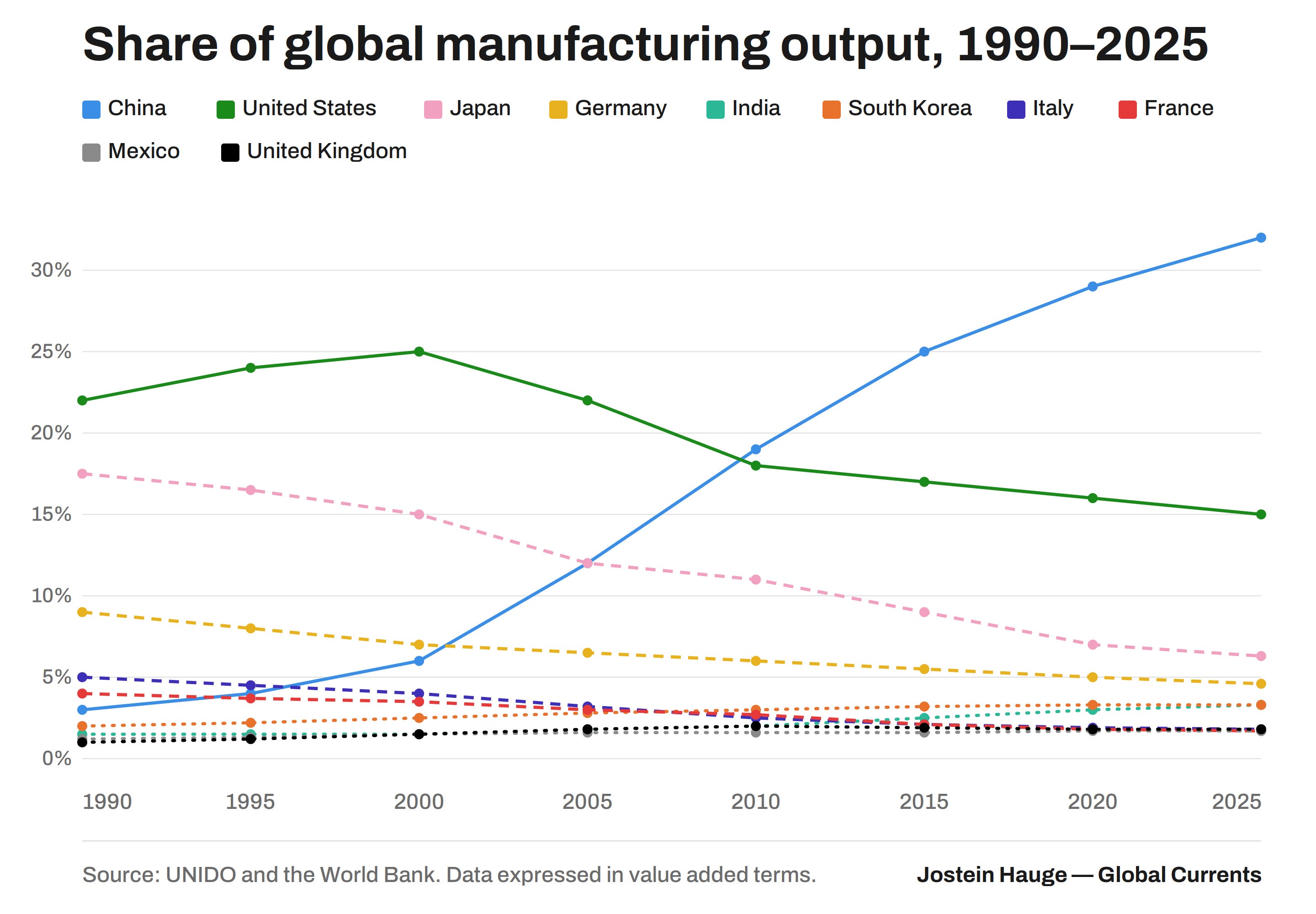
So the disruption is real, and countries are entitled to worry about it and to respond to it, for example with industrial policy measures that helps them either build up or maintain competitive industries. But acknowledging disruption is one thing. The story the West has constructed around that disruption is quite another — and it is this story that I want to take apart.
The problem was never China. It was China not staying put
JD Vance has offered a candid summary of the mood underlying the China Shock narrative. “I am angry about the rise of China,” he said in a speech delivered to the Quincy Institute. It’s worth sitting with the sentiment behind that sentence. The current Vice President of the United States has explicitly declared discontent with the fact that a country of lower income is developing its economy. In a similar vein, when talking about innovation in China, Leland Miller, a member of the US-China Economic and Security Review Commission, stated in an interview: “We want someone to cure cancer, but we don’t want China to control the pipeline for that cure.”
This attitude toward China represents a shift in Western international relations discourse. International development was supposed to be celebrated. Now, we clearly see that it’s only celebrated if it happens on the terms of the West.
Vance is expressing a kind of hegemonic anxiety that is becoming increasingly normalised in the West. And I don’t think this has much to do with China specifically. If India, or the entire African continent, had industrialised and innovated at the same speed and scale, the response from Washington and Brussels would look similar. China’s rise has simply forced a belief out into the open that many in the West kept buried for a long time: a deep discomfort with the idea that “developing” countries might actually develop — that they might compete, might lead, might stop waiting their turn.
Strip away the talk of trade imbalances and national security, and what remains is a simple, unspoken assumption: the West is supposed to be on top. That assumption runs so deep that many people who hold it don’t experience it as a belief at all. It just feels like the natural order of things. So when a country like China grows, it isn’t applauded as a great feat of poverty reduction or development. Instead, it’s treated as a problem, something to be managed, contained, sanctioned, or tariffed back into its place.
Chinese dominance is not okay; US and European dominance is. That’s the unstated rule, and it shows up in at least three places.
Industrial policy. China subsidises its industries, directs credit toward strategic sectors, and protects them while they scale — and this is presented as a violation of the rules of trade. But such measures are hardly unique to China, nor inherently illegitimate. The largest industrial subsidy programme in modern history is the US CHIPS and Science Act — roughly $280 billion, signed in 2022 by a country that championed free trade only as long as it was convenient. The EU has its own defence-oriented industrial strategy that seeks to mobilise up to €800 billion in public and private funds to strengthen Europe’s defence infrastructure and innovation. And state intervention through subsidies, tariffs, and strategic investment has been essential to virtually every country that successfully industrialised. In the 19th century, while catching up with Great Britain, the US maintained the highest average tariff rates on manufactured imports in the world. The ladder was climbed, then kicked away, and it is now being quietly lowered again for Western use only. The Trump administration regularly causes global economic mayhem with its tariffs, having no regard for international trade law. When China uses industrial policy and trade tools, it’s “unfair”; when wealthy countries do it, it’s standard practice.
China’s export-orientation. Wealthy countries welcomed China’s exports with mostly open arms until China became a direct competitor. They welcomed it because it hugely benefited their consumers and corporations. The price of goods and industrial inputs in wealthy nations plummeted after China integrated more deeply into the world economy. This was the intended outcome of policies the West actively championed, including China’s WTO accession in 2001. The objection only surfaced when the composition of Chinese exports started changing — to some degree with the first China Shock and more clearly with the China Shock 2.0. Barely anyone in Brussels or Washington called it a “shock” when China only made t-shirts, furniture, and toys at prices that flattered Western retail margins. It became a “shock” the moment Chinese firms started making the things that compete with what we make. As Vance put it on another occasion, “the idea of globalisation was that rich countries would move further up the value chain while the poor countries made the simpler things.” When China moved up that chain, the West decided the rules of trade were no longer fair. This is a description of a hierarchy, not a rules-based order, and the complaint is that China refused to stay in its assigned tier.
The size of China’s trade surplus. Yes, China’s export volumes are enormous in absolute terms and it has the world’s largest trade surplus. It also has 1.4 billion people. In per capita terms, China’s exports rank only around 104th globally — well below Germany (26th), the UK (42nd), and the United States (63rd). The primary concern turns out to be, essentially, that China is a very large economy growing at a pace that challenges established hierarchies.
These double standards expose a defence of hierarchy, with the West at its apex — one that recasts state-led development as unfair competition, technological self-sufficiency as aggression, and a growing global footprint as domination, even though these are precisely the strategies every successful industrialiser has used.
The history matters here. The West did not stumble into economic entanglement with China. It sought it out because it clearly benefited Western-based corporations and consumers. China was encouraged onto a path of export-led development, and even if this was China’s plan for its own development, it delivered exactly what was wanted of it by Western powers. To now treat the results of that arrangement as a hostile act is to rewrite the story of who asked for what.
What the China Shock narrative conveniently leaves out
If the China Shock narrative were merely an incomplete accounting of the impact of China’s rise in the world economy, and those accounting errors were honest mishaps, that would be forgivable. But the omissions seem to run entirely in one direction, which makes them look less like oversight and more like framing. Here are some of the upsides of China’s integration into the world economy that the narrative glosses over.
The consumer gains in the West have been vast. The price of goods imported into the West has fallen dramatically relative to prices in non-traded sectors since China’s integration into the world economy — in some cases by more than 40%. That is a transfer of purchasing power to Western households on a scale no domestic policy has ever matched. China also delivers strong disinflation to importing countries: cheap Chinese imports have been one of the few forces allowing the cost of services to rise without runaway inflation, because the fall in the cost of tradable goods has helped offset it. China’s rise is a curious kind of threat — one that lowers the cost of living for Americans and Europeans.
China has also quietly subsidised high-paid Western service jobs. Small wealthy countries like my home country, Norway, don’t have to compete in cutthroat global manufacturing, because someone else does it and sells us the output cheaply. This lets wages and labour standards in domestic service sectors sit well above the level they would occupy in a more competitive environment. The comfortable Western service job is, in part, an artefact of the Chinese factory.
Western corporations are among the primary beneficiaries. There’s a persistent misconception that Chinese firms are straightforwardly outcompeting American ones. In some sectors this is true, and increasingly so. But China’s capitalist rise has actually boosted US structural power in certain ways, especially by generating profits for US corporations. Apple is the clearest case. Between 2015 and 2024, it made $227 billion in operating profit in China, over a quarter of its total profits in that period. Through the 2010s, Apple captured 56% of the retail price of the iPhones it released, without making a single component, while the Chinese workers and firms who actually assembled them received about 1.5%. Chinese workers have literally toiled for pennies in factories serving Western markets. When Trump announced steep tariffs on Chinese imports in April 2025, US tech CEOs lobbied furiously — and successfully — to leave the electronics sector untouched, because the supply chains of major US technology corporations, such as Apple, were completely tied to China.
And most egregiously, the climate dividend of China’s export boom is ignored. China now produces 89% of the world’s solar panels, 70% of the world’s wind turbines, 83% of the world’s batteries, and 75% of the world’s electric vehicles — and makes them cheaper than anyone else. China’s clean energy exports totalled $143 billion in 2024, roughly ten times the US figure. China’s rise as a clean energy juggernaut is arguably the single most important development in the fight against climate change. In the middle of a climate emergency, a country is being condemned for making decarbonisation affordable. The accusation, stated plainly, is that China is doing too much of something right.
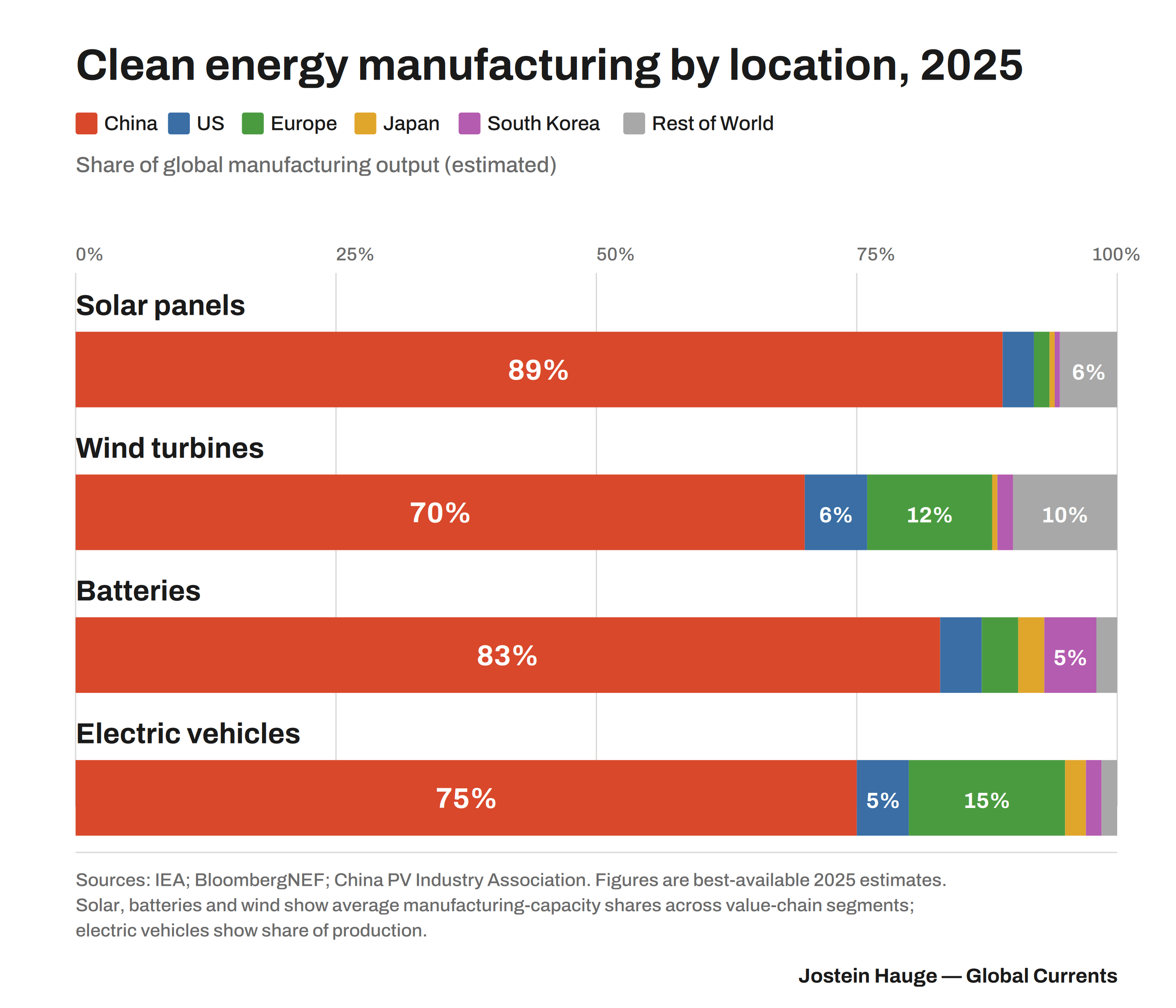
When recently presented with China’s progress in clean energy manufacturing, Germany’s former Health Minister, Karl Lauterbach, responded, “that is insanely sad”. Lauterbach is clearly upset that China rather than Germany is leading this technological revolution. His response echoes the widespread hegemonic anxiety we are witnessing at the moment in the West. Western leaders claim they want to fight climate change, cure cancer, and end poverty — but they cannot allow China to lead the way on any of them.
What is an appropriate response by the West?
Here’s where I may disappoint anyone expecting a purely oppositional conclusion. I push back hard against the worldview underneath the China Shock 2.0 narrative — the assumption, conscious or not, that Western dominance is the natural state of affairs and any deviation is a malfunction. But on the narrow policy question, I don’t actually diverge that far from the more moderate voices in the debate.
Both Europe and the United States should have an industrial strategy, designed to keep or rebuild a robust industrial base. All countries should care about their capacity to make things — not because trade deficits are inherently sinful, but because that capacity is bound up with technological learning, good jobs, and sovereignty. I’ve argued this for years, and I’d argue it regardless of what China was doing.
The mistake is treating industrial policy and engagement with China as opposites. They are not. Industrial policy does not have to be a defensive crouch against Beijing. If the goal is domestic productive capacity, then Chinese manufacturing investment could be an asset rather than a threat, and joint ventures with Chinese firms are a route to capability rather than a surrender of it. This, after all, is precisely how China built its own industrial base — by admitting foreign capital on terms that encouraged technology transfer and domestic learning.
The choice being offered — accept decline or contain China — is a false one, and it’s false because the premise is wrong. China’s rise is not a wound inflicted on the West. It’s the predictable outcome of a development strategy the West was happy to accept and engage with for a long time.
Excellent essay. It strongly echoes the argument I made in Globalization Is Moral When the West Wins: globalization was celebrated as efficient, peaceful and morally progressive when Western capital controlled technology, finance and brands while China supplied cheap labour and low-margin manufacturing.
The moral language changed only when China began moving into electric vehicles, batteries, solar equipment, machinery and advanced manufacturing. What is now called the “China shock” is partly a real industrial challenge, but it is also a crisis of hierarchy. Globalization remains acceptable to the West only when the distribution of power within it remains unchanged.
Great article. But I would like to add that the largest misconception regarding China’s ability to produce things at such affordable price isn’t lower labour costs nor tariffs, its economies of scale, vertical integration, efficient localised supply chains and state owned corporations.
Practically all the heavy industries, plastics, metals, synthetics materials, glass are all made by SOCs in China. There are over 360,000 SOCs in China and they do not maximise profits, they maximise affordability and act as a cushion against international price volatility.
They produce the inputs and energy and sell it to the private sector and households to below profit maximisation levels, this allows the private sector to thrive. As the private sector profits, it pays taxes for the state which operates the SOCs.
This is a system built to ensure stability and growth, the Chinese call it “Socialism with Chinese characteristics,” and it’s a good description.
So when the west realises it’s not subsidies or wages it’s about economic and political systems, the competition is ideological. It’s Capitalism vs Socialism with Chinese characteristics.