

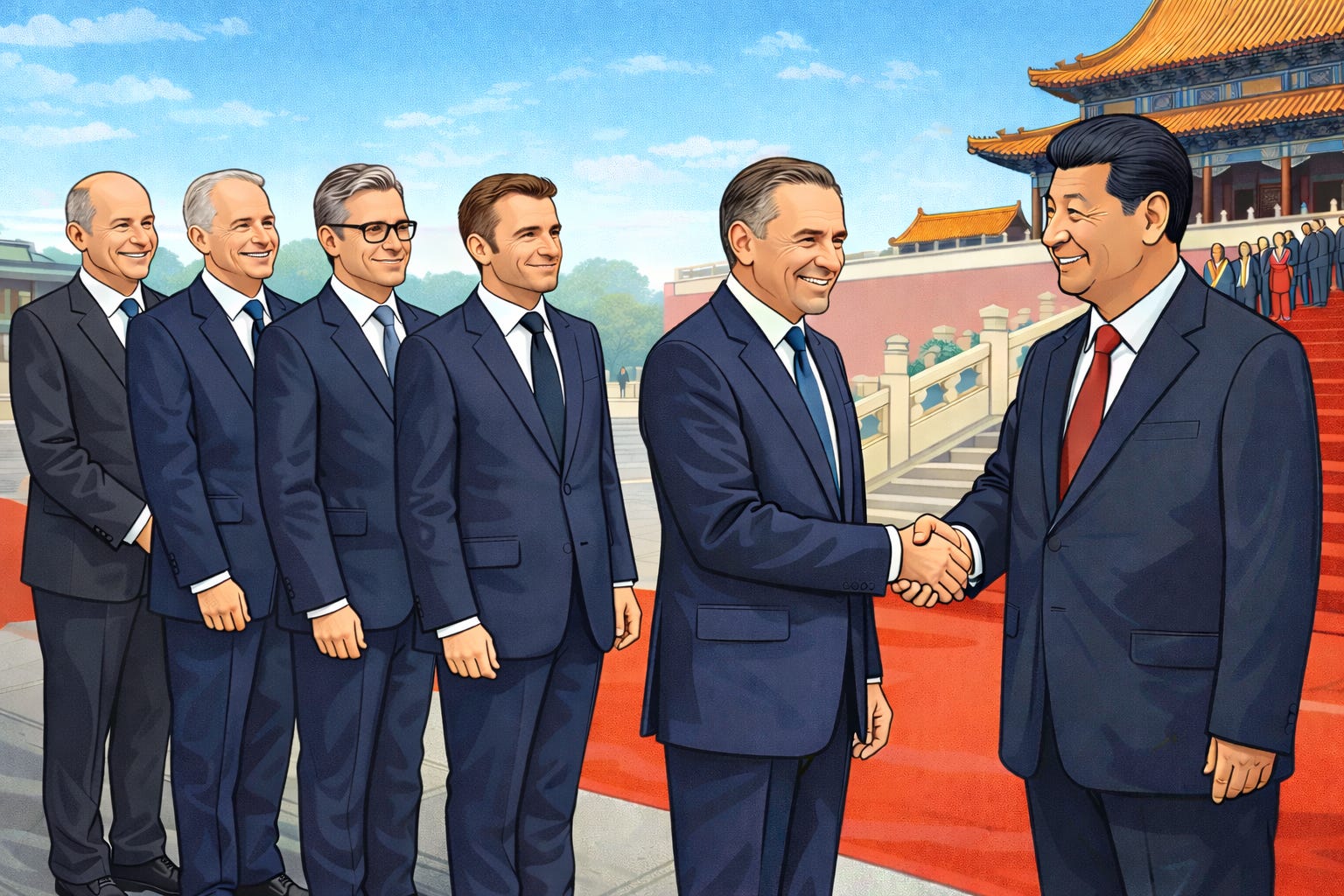
In recent weeks, a parade of Western leaders has made the pilgrimage to Beijing: Irish Prime Minister Micheál Martin, Canadian Prime Minister Mark Carney, UK Prime Minister Keir Starmer, Finnish Prime Minister Petteri Orpo. French President Macron visited late last year.
This is unprecedented. For much of the last decade, China was the country Western politicians loved to bash. Now, Western middle powers are queuing up to strengthen ties with China.
Take Canada. Mark Carney struck a deal allowing up to 49,000 Chinese electric vehicles into Canada annually at reduced tariffs in exchange for lower duties on Canadian canola and other agricultural products. Carney framed the agreement as “preliminary but landmark,” pledging to boost Canadian exports to China by 50% by 2030.
Or consider the UK. Keir Starmer’s visit was the first by a British Prime Minister to China in eight years. He brought more than 50 business leaders with him, including executives from HSBC, AstraZeneca, and Jaguar Land Rover. Shortly before the trip, the UK approved controversial plans for a Chinese mega-embassy in London. The message is clear: Starmer wants deeper economic ties with China, and he’s willing to face down critics to get them.
These visits represent a sharp departure. Western politicians have spent years incorporating anti-China messaging into their campaigns, warning of economic coercion, technological theft, and how China’s rise represents a threat to the model of Western liberal democracy. That rhetoric hasn’t entirely disappeared. But the West is clearly choosing more constructive engagement with China.
What’s driving the shift?
The first reason behind this turn toward a more cooperative stance with China is economic. China now dominates global trade and manufacturing, and has a huge domestic market whose purchasing power is steadily growing. Being on good terms with China when it comes to trade is strategic common sense.
Western middle powers have also watched the risks of reckless opposition to China play out during the first year of Trump’s second term. Throughout 2025, Trump escalated trade tensions with China, imposing new tariffs and export controls. China responded by tightening export restrictions, exposing American dependence on Chinese supply chains. China showed the world that it could respond forcefully when challenged. Middle powers took note.
The second reason is that China has established itself as a trusted, cooperative partner in international affairs, especially when compared to the United States. This may surprise those who consume Western mainstream media, but it’s widely understood elsewhere. A global survey by the Alliance of Democracies Foundation found that 79% of countries around the world have a more positive view of China than of the United States. Another global survey by GlobeScan found that favourable views of the United States have fallen sharply, while perceptions of China have improved significantly.
These poll results reflect the fact that China carries itself with more modesty and dignity on the global stage compared to the United States. China has not invaded another country in 46 years, it does not routinely defy UN resolutions, and it does not carry out regime-change operations in foreign countries. For middle powers navigating an uncertain geopolitical landscape, this predictability matters.
The third reason is Trump. His threats to acquire Greenland, his suggestion that Canada should become a US state, and his erratic trade policies have unsettled allies. Many Western governments now view Washington as unreliable. At Davos, Carney warned that “middle powers must act together because if you are not at the table, you are on the menu.” When middle powers weigh their options, China increasingly looks like the more stable choice.
What about the United States?
The Western middle powers are clearly turning over a new leaf on China. But what about the United States? Right now, America is in a strange, ambivalent place with respect to its relationship with China. American exceptionalism has always rested on the belief that the United States is the natural and rightful hegemon of the world. China’s rise challenges that belief at a fundamental level.
Kaiser Kuo describes this psychological challenge exceptionally well in his recent essay, The Great Reckoning. The below passage from the essay — which I have shared in one of my previous pieces but feel compelled to share again — captures perfectly the cognitive battle that Americans are currently fighting in their own minds:
To understand why China sticks in the craw, one needs to appreciate the deeper psychological challenge it poses to US identity. For generations, Americans inhabited a national story that assured them they would always be first in the domains that matter most—innovation, technology, military might, economic dynamism, cultural magnetism. China’s achievements have systematically undermined pillar after pillar of American exceptionalism.
So, are these reflexes being confronted and are Americans finally becoming more ‘pro-China?’ The answer is mixed.
On the one hand, no. China hawks continue to heavily influence policy discourse in the United States. Framing China’s rise as an existential threat is parroted over and over again in US mainstream media. The Washington establishment remains deeply invested in the narrative of China as an adversary.
On the other hand, yes. Trump has softened US tariffs and export controls on China — although they remain extensive — and he often praises his relationship with Xi. But also Trump suffers from ambivalence, routinely slamming Beijing publicly.
The more solid proof of a vibe shift in the United States comes from public surveys. A recent report by the Carnegie Endowment for International Peace found that 62% of Americans believe their lives would not get worse if China gained more power than the United States. These are not the views of a population gripped by fear of China.
The generational divide is particularly striking. Among Americans aged 18 to 29, only 27% said their lives would worsen if China surpassed the United States. Among those 65 and older, 52% held that view. Younger Americans are far less anxious about China’s rise than their elders.
Where are we now?
The West is clearly embracing China. Even in the United States, where China-bashing is still rife, public sentiment is slowly changing. But we need to be clear-eyed about what this entails.
Much of the engagement is pragmatic rather than principled. Western middle powers are pursuing economic opportunities and hedging against an unpredictable United States. The shift is driven by self-interest, not by any newfound commitment to multipolarity.
We also need to recognise that negative views about China are still shared loud and wide across the West — narratives often full of double standards. When China pursues state-led development, it’s characterised as unfair competition. When it seeks technological self-sufficiency, it’s framed as aggression. When it expands its global economic presence, it’s depicted as domination. Yet these are precisely the strategies that most Western countries employ. Reflexive demonisation of China is far from eradicated.
The West’s embrace of China is real, but incomplete. It’s happening at the level of governments and businesses, driven by economic necessity. Public attitudes are shifting, particularly among younger generations. But old habits die hard, and the narrative war continues.
Still, the direction of travel is clear. Western middle powers are pragmatically pursuing engagement. The United States lags behind, caught between its imperial reflexes and reality. But even in America, the ground is shifting.
This isn’t “the West embracing China.”
It’s middle powers hedging against institutional volatility.
In a constraint-driven world, states route toward predictability not ideology.
China is being treated as legible, not virtuous.
Engagement follows binding capacity, not values.