

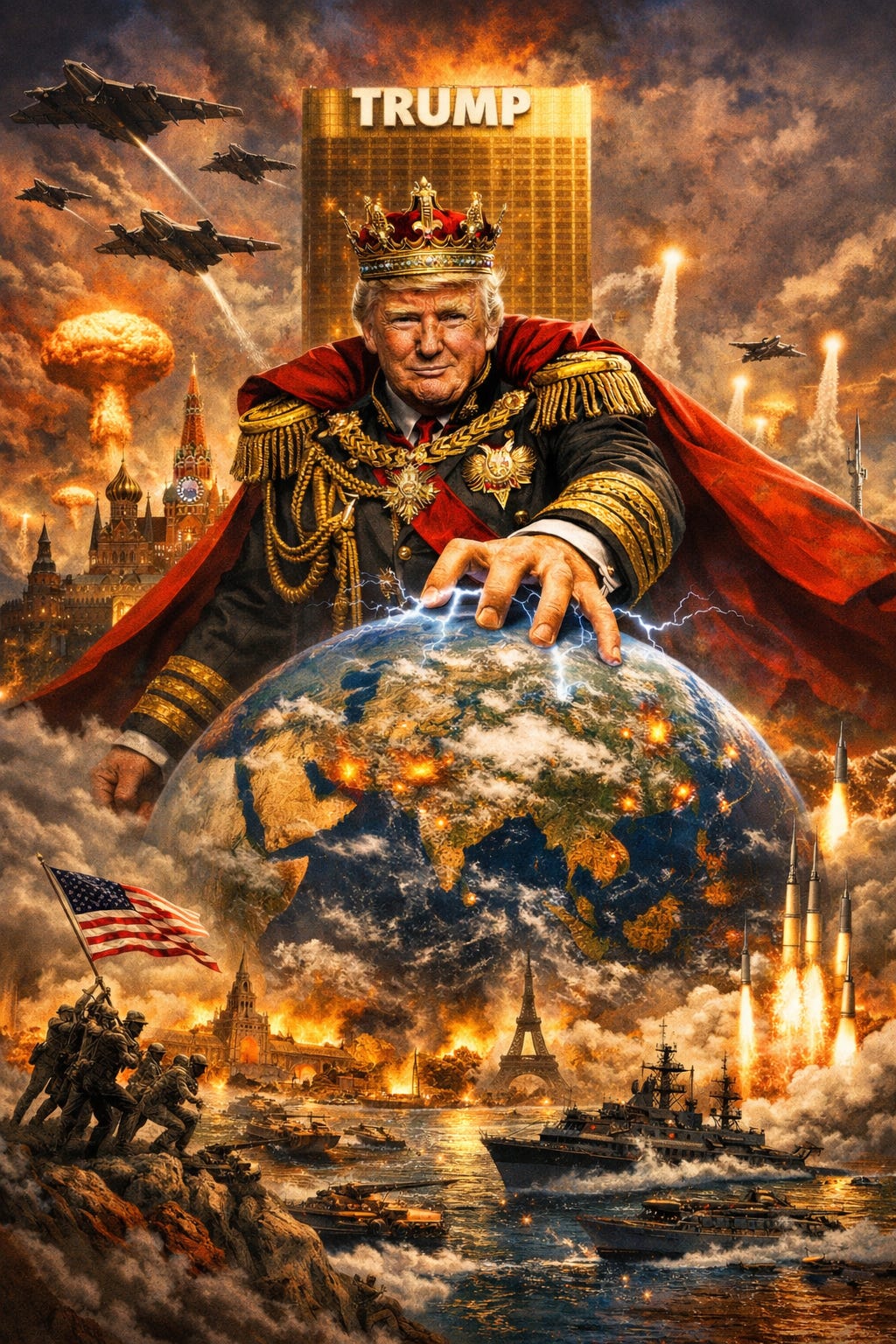
The Trump administration recently published the US National Security Strategy. It’s an extremely important document. It’s an official outline of US priorities in the world, normally published only once every Presidental term. But this time, it’s published at a time of high geopolitical tensions, making it perhaps the most important National Security Strategy this century.
What struck me as most notable with the report is its profound irony. It denounces three decades of American attempts at global domination while articulating a vision of American supremacy more explicit, unapologetic, and comprehensive than perhaps any strategy document since the early Cold War. The strategy condemns the hubris of post-1991 efforts at “permanent American domination of the entire world,” yet it unabashedly demands exclusive preeminence in Latin America, military supremacy throughout the Indo-Pacific, control over critical supply chains, and the right to dictate terms to allies on defence spending and trade policy.
This is not a strategy of restraint or humility. It is suffused with American exceptionalism, asserting that the United States must remain “the world’s strongest, richest, most powerful, and most successful country for decades to come.”
The core critique: what went wrong (according to Trump)
The strategy opens with a sweeping indictment of American foreign policy after 1991 — specifically targeting the national security strategies of the George H.W. Bush, Clinton, George W. Bush, and Obama administrations. While not naming these documents explicitly, the critique clearly targets their central assumptions: Bush Sr.’s “new world order,” Clinton’s “engagement and enlargement,” Bush Jr.’s “freedom agenda” and democracy promotion, and Obama’s “liberal international order.”
These strategies shared common features the Trump document condemns: faith in globalization and free trade as wealth generators, commitment to NATO expansion and alliance management, support for international institutions and multilateral agreements, and emphasis on democracy promotion and human rights. The Obama administration’s 2015 National Security Strategy, for instance, proclaimed American leadership of “a rules-based international order” and emphasized working “through international institutions.” The George W. Bush 2006 strategy declared a goal of “ending tyranny in our world.”
The Trump strategy’s critique is multi-layered but centers on a fundamental claim: these approaches depleted American power in pursuit of ideological fantasies. Economically, free trade policies hollowed out the industrial base and middle class —the very foundation of military capability. Militarily, “forever wars” in Iraq, Afghanistan, and elsewhere exhausted blood and treasure on peripheral nation-building while China rose unchecked. Institutionally, international organizations became vehicles for “anti-Americanism” and “transnationalism” that eroded sovereignty rather than advancing US interests. Strategically, allies free-rode on American security guarantees while running trade surpluses against the United States.
This diagnosis interestingly echoes long-standing heterodox critiques of neoliberal globalization — the offshoring of manufacturing, the prioritization of finance over production, the subordination of worker interests to market efficiency. Yet the document’s solution is not multilateral cooperation or progressive internationalism but rather doubling down on unilateral American power.
It seems, then, that the problem with previous strategies was not their pursuit of dominance but their incompetent execution: they sought global military presence without maintaining the industrial capacity to sustain it, they promoted “free trade” that weakened rather than strengthened American economic power, and they constrained American action through international institutions rather than wielding power directly.
Latin America: unvarnished language of domination
The strategy’s treatment of Latin America is perhaps the most revealing section for understanding its approach to American power. Here, the document abandons diplomatic euphemism entirely. The strategy explicitly declares that the United States will “assert and enforce” hemispheric preeminence, “deny non-Hemispheric competitors the ability to position forces or other threatening capabilities, or to own or control strategically vital assets” in the region, and ensure “continued access to key strategic locations.” This is imperialism stated in plain language.
The sheer scope of privileges demanded by the US is breathtaking. The strategy demands that Latin American countries control migration according to US preferences, combat drug cartels as US proxies, provide manufacturing capacity through “near-shoring,” exclude Chinese investment and infrastructure projects, grant the US military expanded base access and freedom of operation, award “sole-source contracts” to American companies for major projects, and generally align their foreign and economic policies with Washington’s strategic goals. In exchange, these countries receive more favorable treatment on commercial matters — meaning conditional access to US markets calibrated to their compliance.
The policy framework centers on “Enlist and Expand”: enlisting existing partners to advance US interests while expanding American influence to squeeze out competitors, primarily China. The document envisions redirecting US military assets to the hemisphere, potentially deploying lethal force against cartels (an implicit authorization for military operations on sovereign territory), and “establishing or expanding access in strategically important locations”— military bases, in other words, though the document avoids the term.
This is not partnership; it is domination. The strategy explicitly states that “the terms of our alliances, and the terms upon which we provide any kind of aid, must be contingent on winding down adversarial outside influence.” Countries that wish to trade with China, accept Chinese loans for infrastructure, or pursue economic relationships not approved by Washington will face American coercion. The document even advocates using “targeted taxation, unfair regulation, and expropriation” threats to disadvantage US competitors.
The language of sovereignty appears throughout — but only American sovereignty. Latin American nations are expected to “cooperate,” to “align,” to “support,” and to exclude influences Washington deems hostile. When the strategy speaks of “sovereign countries working together,” it means countries exercising their sovereignty in ways that serve US strategic interests. The remarkable aspect is not that the United States pursues influence in its geographic neighbourhood — all great powers do — but that this strategy articulates these goals with such extraordinary frankness, absent any pretense of partnership between equals or respect for the independent agency of Latin American nations.
Previous administrations pursued similar goals but wrapped them in the language of partnership, democracy promotion, or mutual economic benefit. The Obama administration’s 2015 NSS spoke of “equal partnerships” and “shared prosperity” in the hemisphere. This strategy dispenses with such niceties entirely. It is explicit that Latin America matters to the United States instrumentally — to control migration, to stop drugs, to secure critical minerals, to deny China strategic access, and to provide markets and resources for American companies. The region’s own development aspirations appear only insofar as they align with US preferences.
The Indo-Pacific: economic competition and containing China
In Asia, the strategy’s dual character becomes even clearer. The document acknowledges China’s economic rise resulted partly from American policy choices—open markets, offshored manufacturing, technology transfer — but frames the solution not as accepting China as an equal partner but rather reasserting economic dominance through different means. The goal is explicit: prevent China from achieving regional economic dominance.
The military component is equally ambitious. The strategy commits to “denying aggression anywhere in the First Island Chain”— a vast arc from Japan through Taiwan to the Philippines and Indonesia. This requires deeper military integration with allies, expanded base access, hardened forward presence, and massive investments in naval capabilities, undersea warfare, space, nuclear forces, and emerging technologies. The document explicitly identifies preventing Chinese control of the South China Sea as vital to US interests.
This expansive vision comes wrapped in burden-sharing language. The strategy demands that Japan, South Korea, and other allies dramatically increase defence spending. This is framed as ending free-riding and unsustainable American subsidies. But the strategic objective remains unchanged: maintaining a “favorable conventional military balance” and preserving American “overmatch” sufficient to deter Chinese action.
The economic strategy is similarly ambitious. The United States will lead allied coordination to counteract Chinese industrial policy, align export controls, secure critical supply chains, dominate emerging technologies, and shape the economic orientation of developing countries through superior financial tools and infrastructure investment. The goal is not reducing American engagement with Asia but restructuring it to ensure sustained US preeminence across both security and economic domains. The strategy envisions using America’s “$30 trillion economy” combined with allied economies (together “more than half the world economy”) as leverage to subordinate competitors and shape global economic rules.
Europe: political interference and expectations of vassalization
The strategy’s treatment of Europe reveals deep ambivalence. Unlike Asia or Latin America, where clear dominance frameworks apply, the European section reads as equal parts disappointment and civilizational alarm. Europe is characterized as economically stagnant, militarily dependent, politically sclerotic, and facing “civilizational erasure” through migration and loss of national identity.
Most striking is the approach to Russia. The document advocates negotiating “strategic stability with Russia”— treating Russia, unlike China, as a normal great power with legitimate security interests. This reflects a fundamental reordering: Russia is a manageable regional power, while China represents the primary challenge. European anxieties about Russian power are dismissed as overblown.
Yet even toward Europe, the strategy maintains expectations of compliance. It demands increased defence spending (5% of GDP), greater burden-sharing, fairer treatment of US commercial interests, and alignment on countering Chinese economic practices. The document expresses hope for nationalist right-wing movements that might restore “civilizational self-confidence” and loosen EU regulatory authority — essentially endorsing European political fragmentation in favor of bilateral relationships more easily managed by Washington.
Unlike previous National Security Strategies, this document clearly aims to weaken national sovereignty in Europe to pave way for more American influence in European politics.
The Middle East and Africa: reduced engagement
In the Middle East and Africa, the strategy articulates reduced engagement. But even here, core interests remain expansive. The United States will ensure Gulf energy supplies don’t fall to adversaries, that key straits remain open, that terror threats are contained, and that Israel remains secure. The shift is from permanent military presence to episodic intervention and partnership with regional powers — outsourcing security to friendly states while retaining the capacity for strikes and special operations when American interests require it.
Yet “reduced engagement” proves relative. The expectation remains that regional powers will align with American preferences, accept American technological standards, and coordinate their policies with Washington’s strategic goals. Similarly in Africa, the strategy calls for transitioning “from an aid-focused relationship to a trade- and investment-focused relationship,” prioritizing countries “committed to opening their markets to U.S. goods and services” and developing critical minerals under American rather than Chinese partnerships. The rhetoric of partnership barely conceals the underlying premise: these regions matter to the United States primarily for what they can provide (resources, markets, strategic access) and engagement will be calibrated to their willingness to advance American economic and security interests.
Conclusion: domination by different means
The central irony of Trump’s 2025 National Security Strategy is profound: it condemns the post-Cold War pursuit of “permanent American domination of the entire world” while demanding American supremacy more explicitly than perhaps any strategy document since the early Cold War. The Bush, Clinton, and Obama strategies at least gestured toward multilateralism and partnership, justifying American power through universalist claims about democracy and rules-based order. This strategy dispenses with such pretenses entirely. It represents a move from liberal internationalist domination to nationalist domination.
The document’s lack of international humility is striking. Other nations should “put their interests first,” but only when aligned with American preferences. The strategy proclaims respect for other nations’ “differing cultures and governing systems” while declaring European civilization faces erasure and Latin American countries must restructure their economies to serve American supply chains. There is no acknowledgment that allies might have valid reasons for diversifying partnerships.
Whether this vision is sustainable depends on assumptions the strategy never questions: that allies will increase defence spending without seeking corresponding influence, that US tariffs will rebuild manufacturing without triggering retaliation, and that other powers will accept permanent American supremacy even while managing their own regions.
The deepest irony is that this strategy, which condemns the hubris of its predecessors, may represent the most hubristic American foreign policy document in a generation: one that demands explicit, comprehensive American dominance while simultaneously claiming to reject the very concept of global domination.
This is heading towards Thucydides Trap right? Please write and talk more about this. Any thoughts on would the democrats continue along this same line if they are back? Man I just finished hardcore history podcast episodes about the ww2 battle on the eastern front, no way I want to live when the ww3 breaks out..
This isn’t imperialism rediscovered.
It’s post-legitimacy strategy: fewer norms, fewer stories, more direct control.